Ask two people how full a silo is and you get two different measurements. One reads the load cells and says 312 tonnes. The other reads the level sensor and says 78 percent. Both are right, and they are not the same number.
The two questions#
How much is in it is a stock question. It decides whether to book a delivery, whether the mill runs through the weekend, and what the month-end figure is. The answer is a quantity: tonnes, or kilograms.
How far down is the surface is a geometry question. It decides whether the fill pipe clears, and it is what a level sensor actually measures.
Turning the second into the first needs the material's bulk density and the vessel's shape. Both move. Bulk density changes with moisture and with how recently the silo was filled. The cone at the bottom means the last twenty percent of the height is not the last twenty percent of the mass.
Load cells, and why they survive a dusty headspace#
Load cells sit under the silo legs and weigh the whole vessel. The reading is the mass of everything inside it, whatever shape that mass is in. Dust, a crust on the surface, an uneven cone: none of it changes the answer.
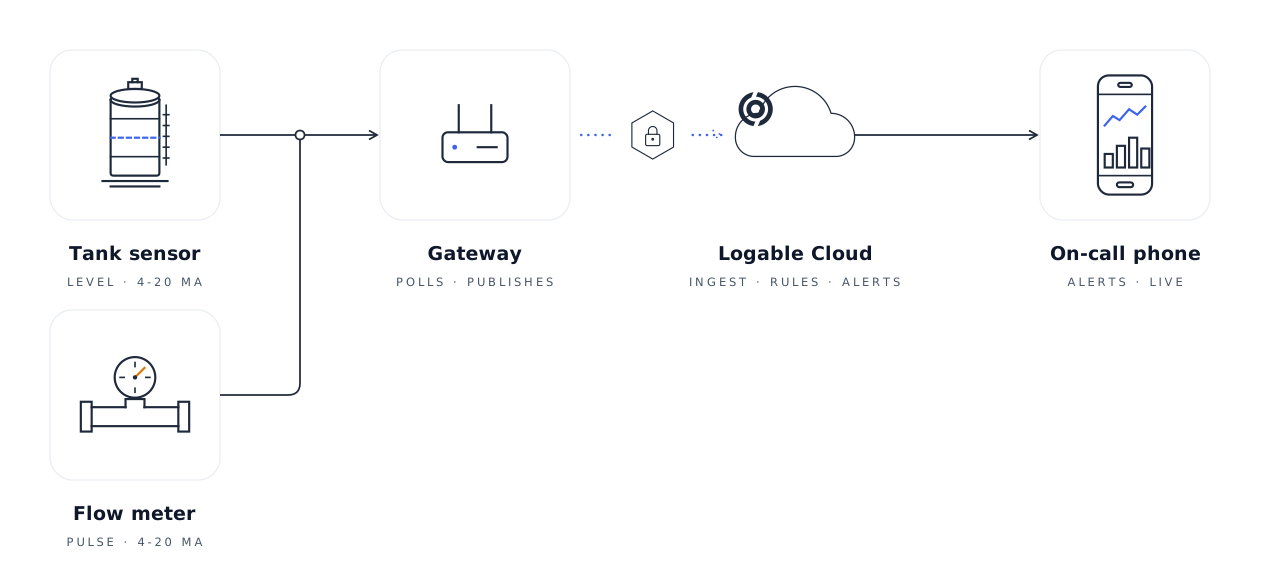
The indicator turns the load-cell signal into a number and exposes it, usually over Modbus. That number is already the answer to the stock question, with no conversion and no assumption about density.
The trade is installation. Load cells go in when the silo goes up, or during a shutdown.
Level sensors, and the conversion they need#
A radar or ultrasonic sensor in the silo roof measures the distance to the surface. It is easy to retrofit, and that is why it is common.
To answer the stock question it needs two more things: the vessel's volume as a function of height, and the material's bulk density. Most indicators and most gateways can hold that conversion. Do it before the reading reaches Logable, at the indicator or in the gateway, and send the result as weight.
Why Logable's silo type stores weight#
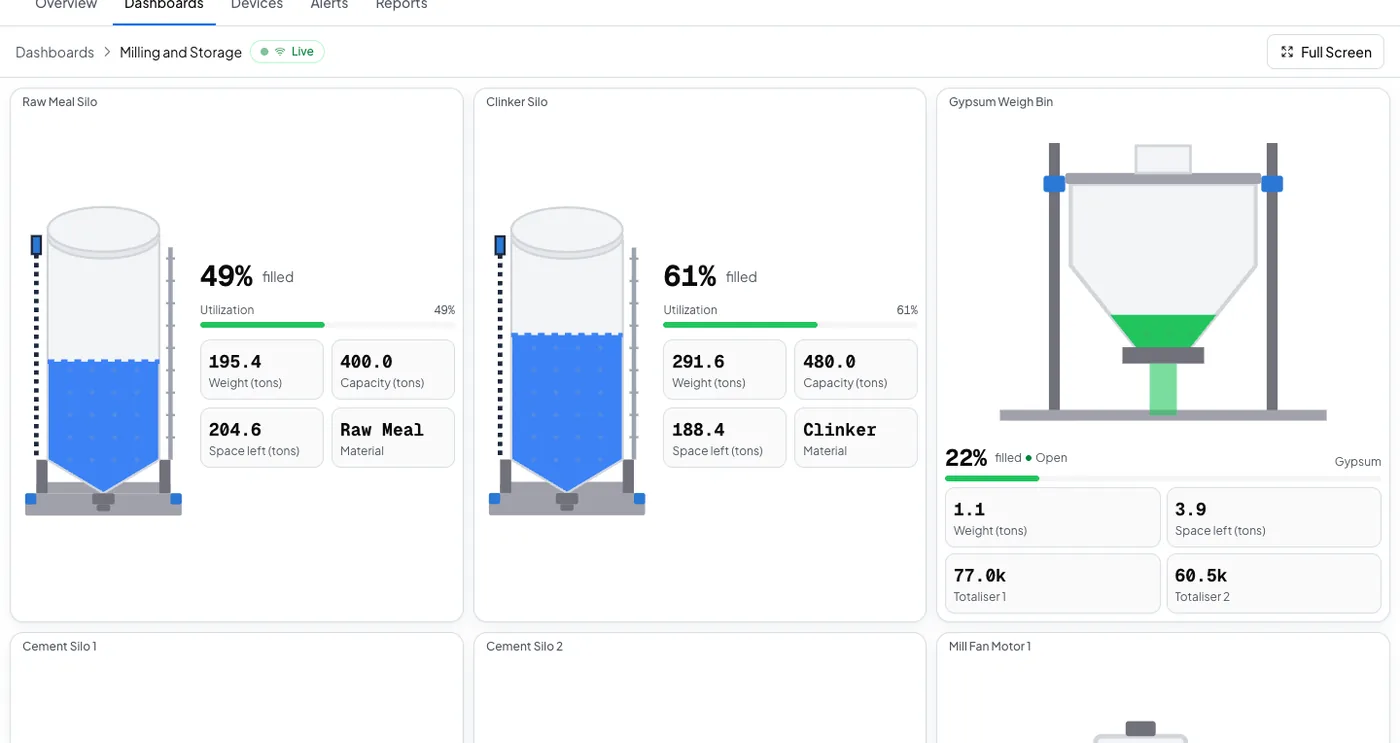
A Logable silo has one metric, weight, and one configuration field that matters, capacity. Every silo preset is a percentage of that capacity. Running low fires at 20 percent, critically low at 5 percent, nearly full at 90 percent.
Storing one quantity means the alert, the chart, the report and the forecast all agree. If the platform stored level on some silos and weight on others, every one of those would need to know which, and the first place it would go wrong is the alert.
Bridging and rat-holing, on a weight chart#
Two failures show up clearly once the history is a weight chart.
Bridging is material arching over the outlet. The silo keeps feeding from below until it empties the space under the arch, then the weight line goes flat while the plant keeps drawing. A flat line during production is the signal.
Rat-holing is material funnelling straight down the middle while the sides stay stuck. Weight falls faster than the recipe says it should, then stops well above empty.
Neither is visible from a single reading. Both are obvious on a week of history, which is why the chart matters as much as the current number.
The two alerts, and what they fire at#
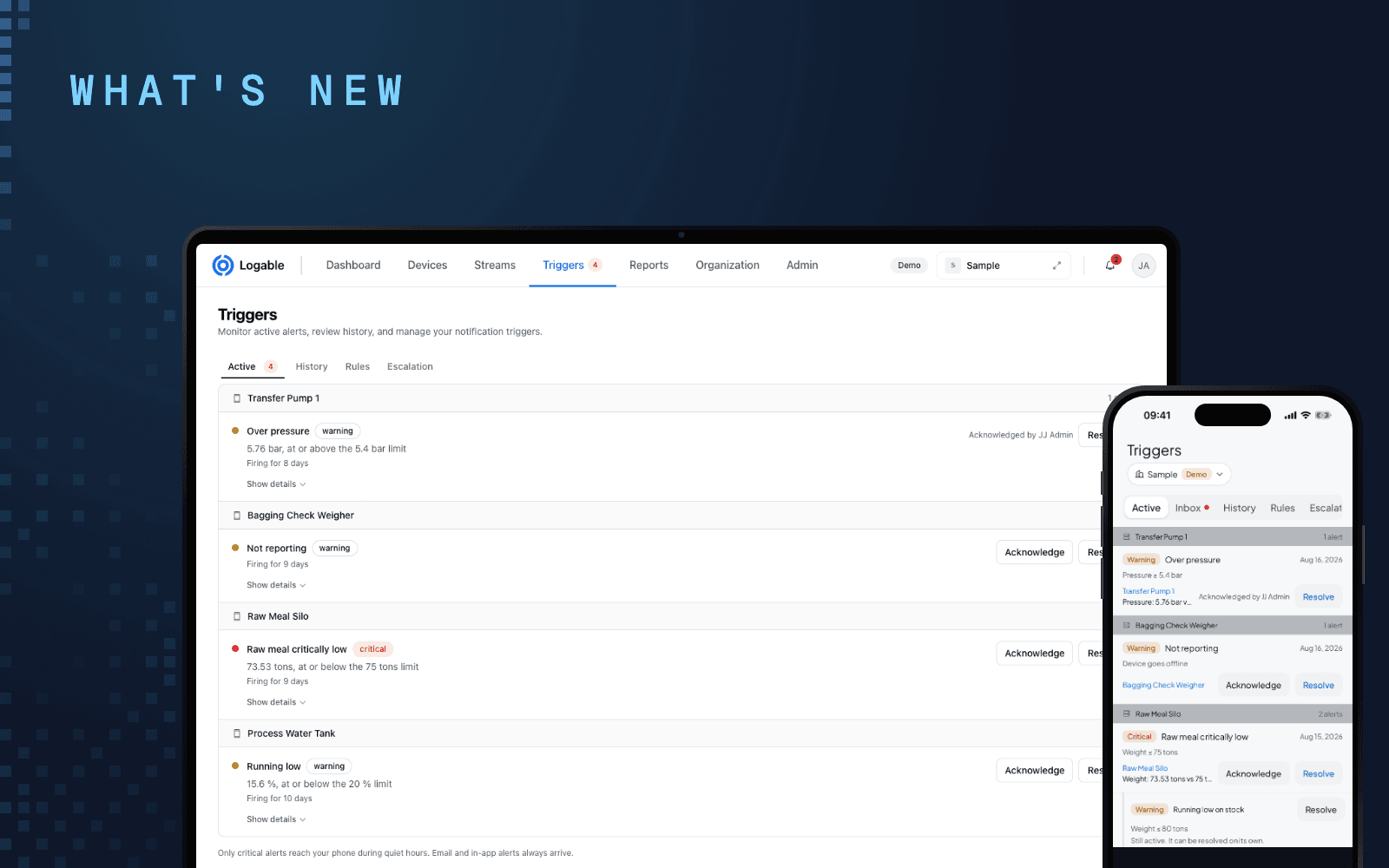
Running low on stock fires at 20 percent of the capacity you set, and clears at 35 percent. That gap is wide enough that one delivery does not reopen it. The banner reads the device name and the preset's own sentence: "Raw Meal Silo running low on stock". The operator books a delivery.
Critically low on stock fires at 5 percent, which is the point where production stops without an emergency delivery. It is the only silo preset that is worth waking somebody for.
Both need capacity to be right. A wrong capacity makes both alerts wrong, in the same direction, quietly. It is the one number to check twice when the silo is added.
Start here#
- Silo monitoring, the whole picture.
- Monitor a silo remotely, the six steps.
- Silo device type reference, every metric and configuration field.