The borehole, watched.
You hear the same day it stops.
A borehole pump is a water pump at the bottom of a hole, on a farm somebody visits once a week. Logable watches what it pushes, what it moves, and whether it is reporting at all.
- The same day
- not the next weekly visit
- Three readings
- pressure, flow, and whether it reported
- Solar and 4G
- one outbound link from the hole
The borehole is the one asset nobody visits until it fails.
The trough is empty on Thursday. The pump stopped on Monday when the power went, and four days of water went missing while everything looked normal.
- An hour away, on the screenThe pressure and the flow at the borehole, from the farmhouse or the road.
- Power cuts are the common failureWhen the pump stops reporting, the alert says so, and says again when it comes back.
- Days become the same dayThe gap between a pump stopping and somebody knowing is the whole cost.
The pump, and the tank it fills
A pump reporting normal flow and a tank that is not filling is a clear answer. Either one alone is a guess.
A pump that stops does not wait for the next visit.
Discharge pressure and flow on the rising main, against the rating you set.
The tank at the other end says whether the water arrived.
Live level in the tank the borehole fills, as a percentage of full.
What the borehole delivered, as a number.
Instantaneous flow and the total volume off the borehole.
What to collect from a borehole
Three readings. What it pushes against, what it moves, and whether anything arrived at all.
| Reading | Unit | What it tells you | Where it comes from |
|---|---|---|---|
| Discharge pressure | bar | what the pump is pushing against on the rising main | the transmitter at the wellhead |
| Flow rate | L/min | whether the borehole is actually delivering | the meter on the rising main |
| Tank level | % | whether the water reached the other end of the pipe | the level sensor in the storage tank |
From the wellhead to the farmhouse
A pressure transmitter at the wellhead reports over a 4G router. There is no site network, no plant LAN and no cable back to a building.
- Pressure transmitterAt the wellhead
- 4-20 mA · Modbus RTU
- 4G routerSolar · Outbound only
- MQTT, encrypted
- Logable CloudRules · History
- Push · Email
- Farmhouse phonePush · 7.4 bar
One Logable device is one borehole. A farm with three boreholes publishes to three device topics, each with its own rating and its own history.
Power and signal at the hole
| Protocol | How it reaches Logable | Notes |
|---|---|---|
| MQTT | Direct to Logable | The 4G router or the gateway publishes to Logable over MQTT with TLS, on port 8883. |
| HTTPS | Direct to Logable | A logger at the wellhead can post the same reading to the Logable API instead. |
| Modbus RTU | Through a gateway | An RS-485 transmitter is read by the gateway at the wellhead, never by Logable. |
| Modbus TCP | Through a gateway | An Ethernet transmitter is polled by the same gateway. |
The instrument is rarely the hard part on a borehole. Power at the wellhead and a signal off it usually are. A solar panel, a small battery and a 4G router cover both, and the link is outbound only. See how to connect a PLC or a Modbus device via a gateway.
Load shedding is the most common reason a borehole pump in South Africa stops, and from the data it looks the same as a dropped link: the device stops reporting, and somebody has to go and see which it was. The alert is still what turns a four day gap into the same day, on a farm an hour from the house.
The borehole, on the farmhouse screen
Pressure and flow at the wellhead, with the history that shows a pump slowing rather than stopping.
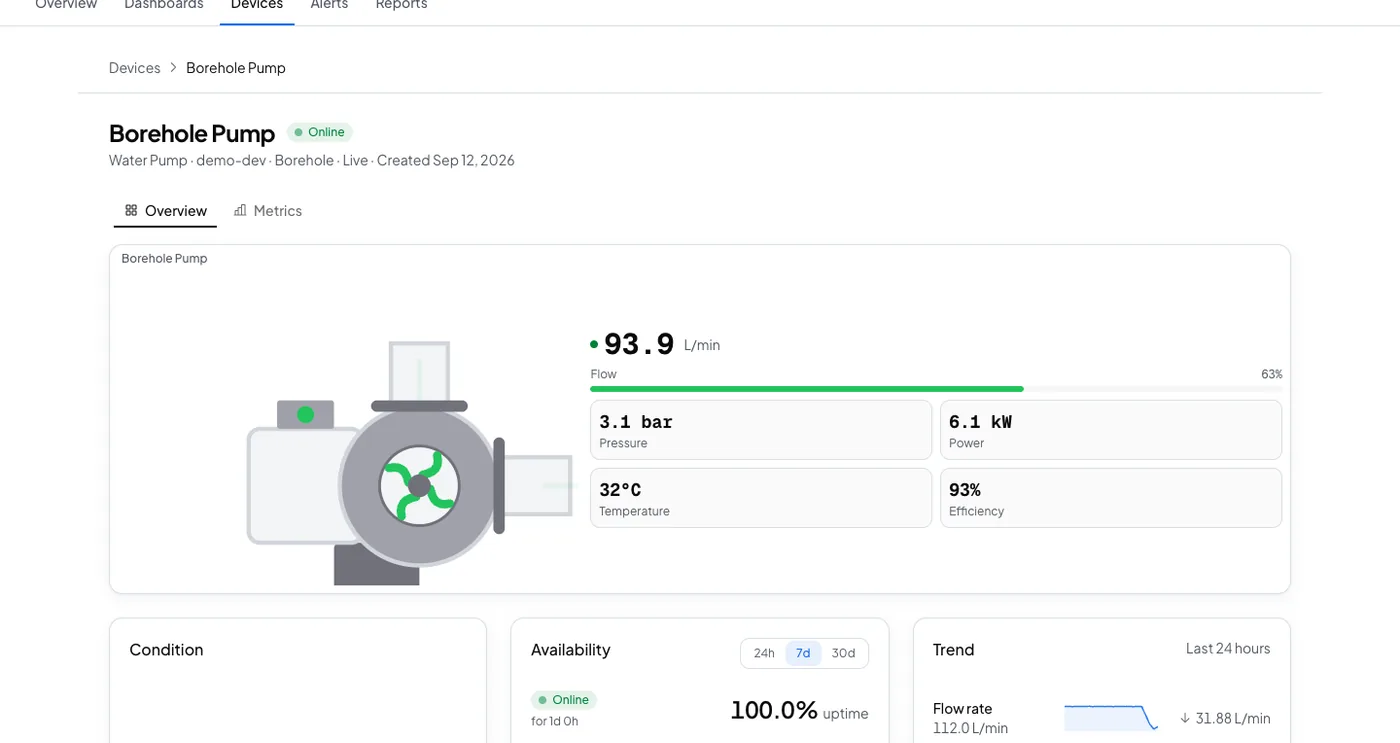
An hour away is still the same day.
The gap between a borehole stopping and somebody knowing is the whole cost. Logable closes it to minutes.
The alerts a borehole is worth having
Three presets. The one that matters most on a farm is the one that fires when nothing arrives at all.
- Over pressure
Tells you when discharge pressure reaches 90 % of the pump’s rated maximum.
- Not reporting
Tells you when this device stops sending data, and again when it comes back.
- Running low
Tells you when the tank drops to 20 % full, so you can refill before it runs dry.
The farm is an hour away. The borehole is in your pocket.
Borehole Pump passes 90 percent of its rated pressure and the push carries the pump and the reading, so the drive out happens with the right part in the bakkie.
- The reading, not just a pingThe push names the borehole and the pressure on it.
- Silence is an alert tooA pump that stops reporting raises its own alert, and another one when it comes back.
- The tank, on the same screenSee whether the water reached the other end before you decide to drive.
What goes wrong at a borehole
Three failures, and what each looks like from the farmhouse.
| What happens | What you see today | What Logable does |
|---|---|---|
| The rising main blocks or a valve is shut. | The pump runs hard and delivers nothing until something fails. | The over pressure alert fires at 90 percent of the rating, with the reading in it.Over pressure |
| The power goes, or the 4G link drops. | The dashboard keeps the last reading, and the trough is empty four days later. | The not reporting alert fires after five minutes of silence, and again when it returns.Not reporting |
| The storage tank stops filling. | Nobody connects an empty tank to a pump that looks fine. | The tank's running low alert fires at a fifth full, beside the pump's own readings.Running low |
Borehole operations
Pressure and flow at the wellhead over the week, with the volume delivered and the pump's uptime.
The same report template that covers a plant room covers a borehole: pressure and flow for the period, the volume delivered and the uptime, so a month of a borehole's behaviour is one document rather than a scroll through a chart.
What it costs to watch three boreholes
Sized by how many devices report, not by how far apart they are.
The trial runs 14 days with 5 devices and Growth features, and asks for no card. Industry plans are quoted per site.
The transmitter, the 4G router and the solar supply are bought once from your supplier and are not a Logable cost.
Frequently asked questions
What teams ask before they connect the first device.
Put a pressure transmitter or a flow meter on the rising main, and a gateway or a 4G router at the wellhead. Add the pump as a water pump device, set its rated pressure, and the readings reach Logable over MQTT. The alert reaches the farmhouse phone.
No. A borehole pump is a water pump, and this page says so rather than inventing a type. What differs is where it sits and how it fails, not what it measures. You add it as a water pump and set its rated pressure and flow.
A pressure transmitter or a flow meter on the rising main, a gateway or a 4G router to carry the reading out, and power for both. A solar panel and a small battery cover the power where there is no mains at the hole.
The pump stops reporting, and the not reporting alert fires. Logable decides a device is offline after five minutes of silence, or three times its own reporting interval when that is longer. From the data a power cut and a dropped link look the same, and the alert says the device went quiet rather than guessing which.
Logable is priced by how many devices report. Three boreholes is three devices, and the section above resolves that to a plan from the current ladder. The full ladder is on the pricing page. The router and the transmitter are one-off costs from your supplier.
Also for tanks, dams and plant pumps
Water Tank Monitoring
The tank at the other end of the pipe.
Learn moreDam Level Monitoring
Level and stored volume from the wall.
Learn morePump Monitoring
The same readings on a plant room pump.
Learn moreRunning boreholes on a farm? monitoring for agriculture or read how to detect pump failure remotely.
Put the first borehole on a dashboard
Connect the transmitter through a 4G router, set the rated pressure, and add the presets.