Every tank, live.
Refilled before it runs dry.
A level sensor in the tank already knows how much is left. Logable stores that as a percentage of full, watches it, and tells somebody before the tank empties or spills.
- Before it is dry
- the alert fires at a fifth full
- Before it spills
- and again at nine tenths
- A burst line
- shows as a fall inside an hour
The tank is empty, and the sprays are already off.
Dust Suppression Tank reads 18 percent on a Friday afternoon. The refill is scheduled for Monday, and the yard runs without dust suppression all weekend.
- Level, live, per tankEvery tank on one board, as a percentage of full, with the history under it.
- Two limits, two alertsOne before the tank runs dry, one before it overflows.
- A leak is a rate, not a levelA fall of 15 percent inside an hour is its own alert, because that is not normal use.
The tank, the pump and the meter
A level that falls tells you something. The pump and the meter tell you what.
A tank running low is refilled before anything stops.
Live level as a percentage of full, with the history that shows how it got there.
The pump filling the tank is watched beside it.
Discharge pressure and flow on the pump that fills or draws the tank.
What went in and what came out, as a number.
Instantaneous flow and the total volume through the line.
What to collect from a water tank
One level answers the question. Flow either side of it says whether the answer is changing for a good reason.
| Reading | Unit | What it tells you | Where it comes from |
|---|---|---|---|
| Tank level | % | how much is left before the tank runs dry | the ultrasonic or pressure level sensor in the tank |
| Fill flow rate | L/min | whether the tank is actually filling | the pump's own flow reading |
| Total volume | L | what the site has drawn over the period | the meter on the outlet |
From the level sensor to the phone
A level sensor in the tank reports to a gateway on site. The gateway publishes to Logable, and the alert reaches whoever refills the tank.
- Level sensorIn the tank
- 4-20 mA · Modbus RTU
- GatewayConverts · Publishes
- MQTT, encrypted
- Logable CloudRules · History
- Push · Email
- PhonePush · 18 %
Logable stores level as a percentage of full, so convert a distance or a head to a percentage at the transmitter or in the gateway, before the reading arrives. That keeps one number on the platform and every tank preset reading the same thing.
The sensor and the gateway
| Protocol | How it reaches Logable | Notes |
|---|---|---|
| MQTT | Direct to Logable | The gateway publishes to Logable over MQTT with TLS, on port 8883. |
| HTTPS | Direct to Logable | A gateway or a logger can post the same reading to the Logable API instead. |
| Modbus RTU | Through a gateway | An RS-485 level transmitter is polled by the gateway, never by Logable. |
| Modbus TCP | Through a gateway | An Ethernet transmitter or PLC is polled by the same gateway. |
An ultrasonic sensor in the roof or a submersible pressure sensor at the bottom both work. Either gives a distance or a head, which the transmitter or the gateway turns into a percentage of full before it reaches Logable. See how to connect a PLC or a Modbus device via a gateway.
The tank, on one screen
Level as a percentage of full, with the history that shows the draw-down.
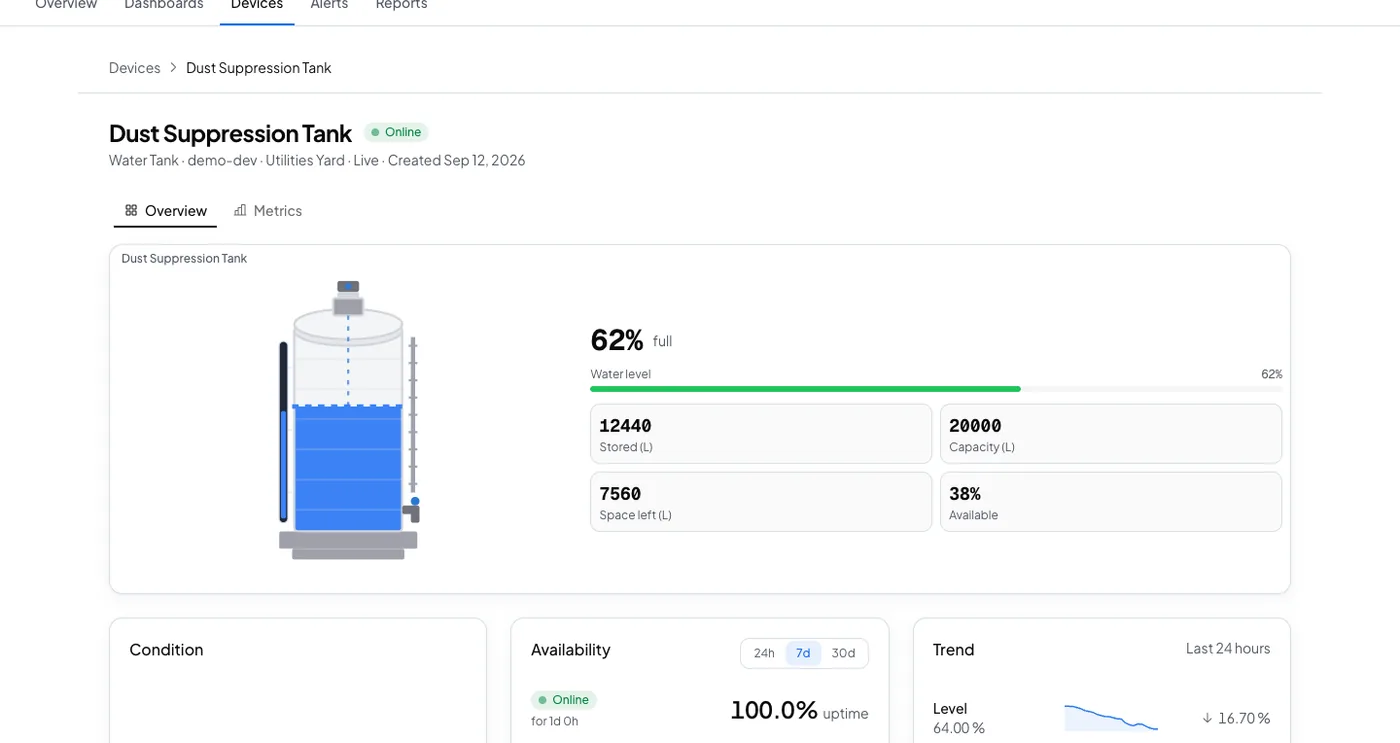
A tank that runs dry is a tank nobody watched.
The sensor is already in it. Logable reads the level, keeps the history, and tells somebody at the limit you set.
The alerts a tank is worth having
Four presets cover the empty end, the full end, the leak and the silence.
- Running low
Tells you when the tank drops to 20 % full, so you can refill before it runs dry.
- Nearly full
Tells you when the tank passes 90 % full, so you can stop the inflow before it overflows.
- Draining faster than normal
Tells you when the level falls by 15 % within an hour.
- Not reporting
Tells you when this device stops sending data, and again when it comes back.
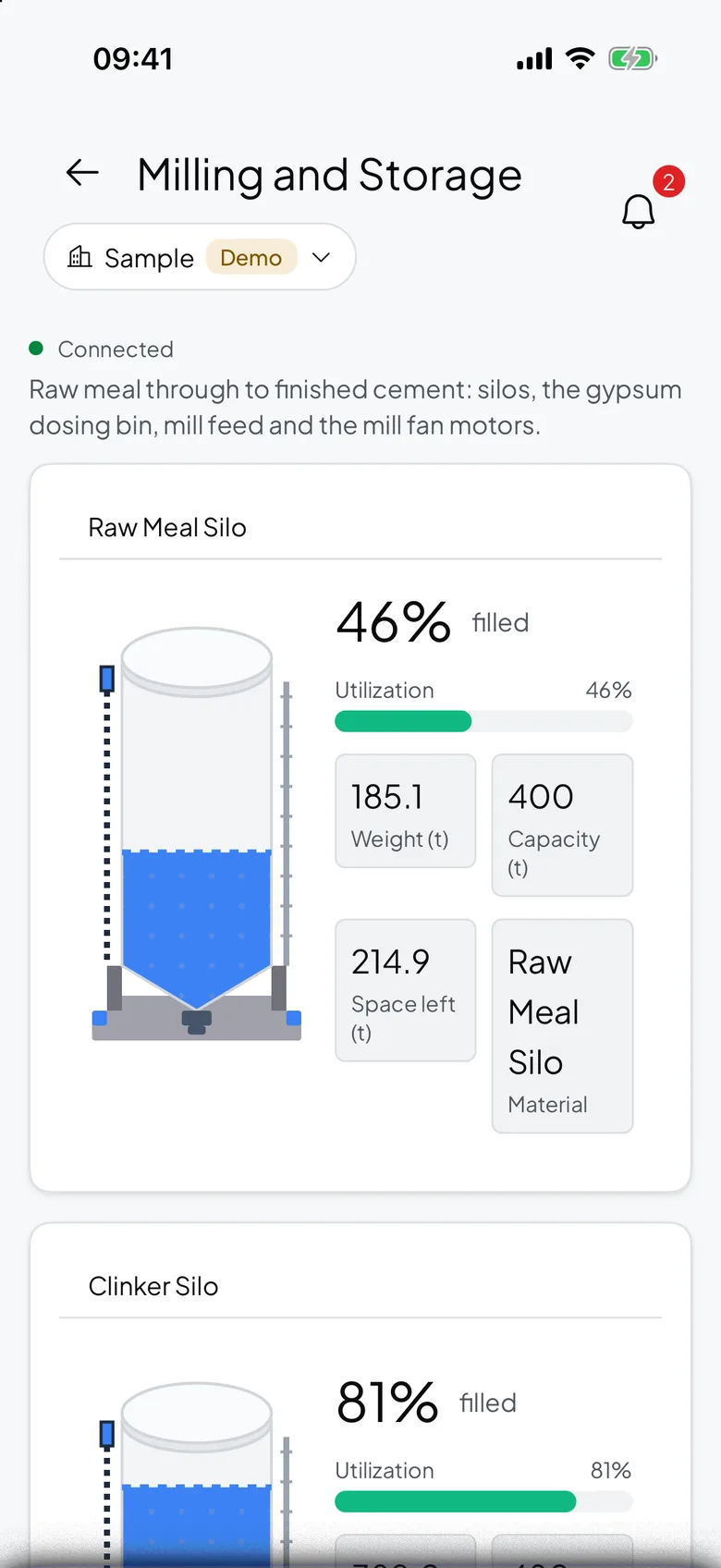
The tank is in the yard. The level is in your pocket.
Dust Suppression Tank drops under a fifth full on a Friday. The push names the tank and the level, so the refill is arranged before the weekend.
- The level, not just a pingThe push names the tank and the percentage, so the call is made straight away.
- Acknowledge onceThe reminders stop, and the next person is told if nobody acts.
- The history, from the roadSee how fast it is falling before you decide whether it can wait.
What goes wrong, and what changes
Three ways a tank costs a site, and the preset for each.
| What happens | What you see today | What Logable does |
|---|---|---|
| A tank runs dry over a weekend. | The sprays or the process stop, and nobody knows why until Monday. | The running low alert fires at a fifth full, with the level in it.Running low |
| The inflow is left on and the tank overflows. | Water is lost and the floor is wet. | The nearly full alert fires at 90 percent, in time to close the valve.Nearly full |
| A line bursts under the yard. | The loss reads as normal use until the tank is empty. | A fall of 15 percent within an hour raises its own alert.Draining faster than normal |
What it costs to watch six tanks
Sized by how many devices report, not by how much water they hold.
The trial runs 14 days with 5 devices and Growth features, and asks for no card. Industry plans are quoted per site.
The level sensor and the gateway are bought once from your supplier and are not a Logable cost.
Frequently asked questions
What teams ask before they connect the first device.
Add the tank as a device, set its capacity, and send the level as a percentage of full. A gateway reads the level sensor and publishes over MQTT. The dashboard updates live, and the alert reaches a phone at the level you set.
An ultrasonic sensor in the roof or a submersible pressure sensor at the bottom both work. Either gives a distance or a head. Convert that to a percentage of full at the transmitter or in the gateway, because Logable stores tank level as a percentage.
Yes. The nearly full preset fires at 90 percent full and clears at 80 percent, which is a wide enough gap that normal filling does not flip it back off. The push names the tank, so the right valve is closed.
Yes. The draining faster than normal preset fires when the level falls by 15 percent within an hour, which is well beyond what normal use draws down in that time. Two matching readings in a row rule out a single odd sample.
Also for pumps, dams and boreholes
Pump Monitoring
Pressure, flow and power on every pump.
Learn moreDam Level Monitoring
Level and stored volume from the wall.
Learn moreBorehole Pump Monitoring
The pump that fills the tank, on a farm.
Learn moreRunning tanks across a site or a farm? monitoring for water and utilities or read how to monitor a water tank remotely.
Put the first tank on a dashboard
Connect the level sensor through a gateway and add the two limits that matter.