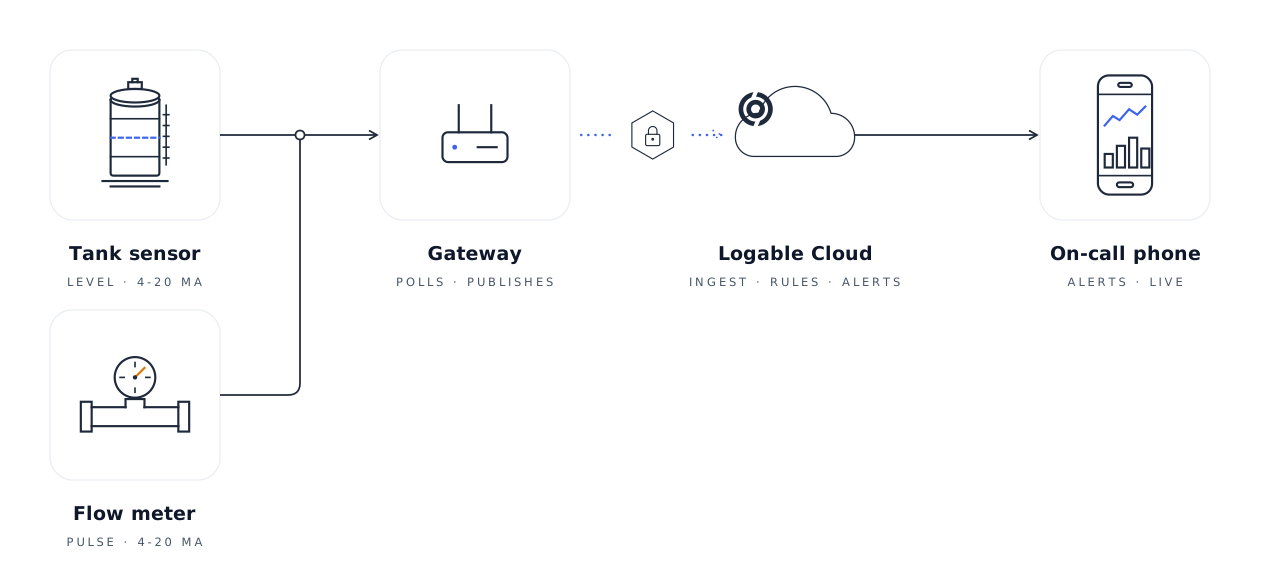
A borehole pump sits at the bottom of a hole, on a farm somebody drives out to once a week. It runs, or it does not, and the way you find out is usually a dry trough or an empty tank.
The three readings worth having#
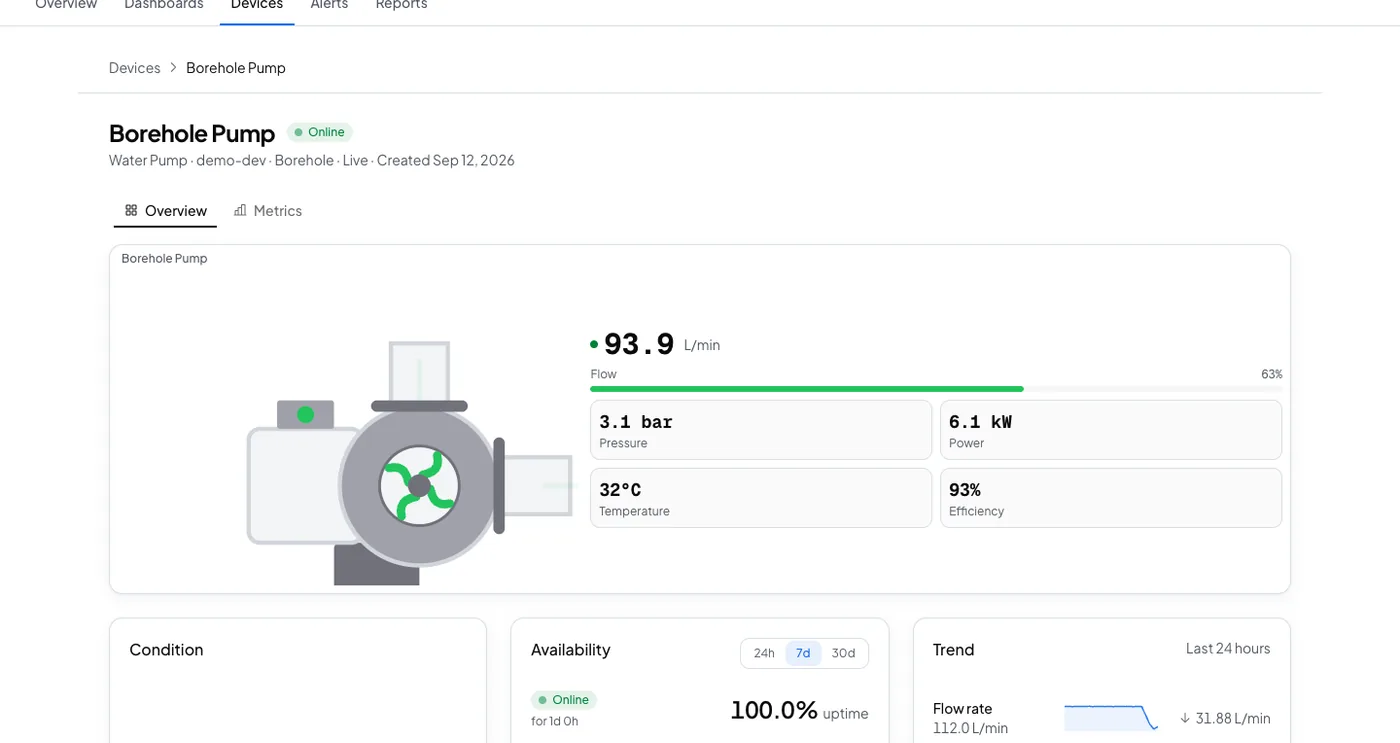
Discharge pressure is what the pump is pushing against. A pressure transmitter on the rising main gives it. It is the single most useful number, because almost everything that goes wrong changes it.
Flow is what the pump is actually moving. An inline meter gives it. Pressure without flow is the signature of a pump working hard and achieving nothing.
Whether anything arrived at all is the third, and people forget it. A dashboard showing the last reading looks exactly like a dashboard showing a live one.
What each failure looks like#
A closed valve or a blocked line. Pressure climbs, flow falls. The Over pressure preset fires at 90 percent of the maximum pressure you set for that pump, and clears at 80 percent. The push banner reads the device name and the preset's own sentence: "Borehole Pump over pressure".
A dropped 4G link. No readings. The Not reporting preset fires after five minutes of silence, or three times the pump's own reporting interval when that is longer, and it tells you again when the link comes back.
The power went. From Logable's side this looks identical to a dropped link, and that is honest: the device stopped reporting, and somebody has to go and see which it was. Load shedding makes this the most common of the three on a South African farm.
Why there is no dry-run alert#
A dry run is two facts at once. The pump is running, and there is no flow. An alert rule reads one metric at a time, so no single rule can express it, and Logable does not pretend otherwise.
What it does instead is show the state. The pump tile on the Overview reads no flow, with the discharge pressure beside it, whenever a pump is running and its flow rate is at or below zero. It is there the moment you open the app, and it needs no configuration.
The closest thing to an early warning is the Low flow preset on the supply meter, which covers the upstream half. Detect pump failure remotely sets out the whole failure set and which of them alert.
Watch the tank at the other end#
The pump and the tank it fills explain each other. A tank that is not filling while the pump reports normal flow means the water is going somewhere else. A tank draining faster than usual while the pump is off means a burst line, and the Draining faster than normal preset catches it at a fall of 15 percent within an hour.
Watching both costs one more device and turns two ambiguous readings into one clear answer.
Power and signal on a farm#
The instrument is rarely the hard part. Power at the borehole and a signal off it usually are.
A gateway or a 4G router makes one outbound connection, so no fixed line and no inbound port is needed. Many gateways buffer locally and upload when the link returns, so a dropout costs you the gap and not the history. Solar and a small battery cover the head when there is no mains at the hole.
What it costs#
Logable is priced by how many devices report. Three boreholes is three devices. The gateway, the 4G router and the transmitter are bought once from your supplier and are not a Logable cost. Pricing has the ladder.
Start here#
- Borehole pump monitoring, the whole picture.
- Detect pump failure remotely, the failure catalogue.
- Water tank monitoring, the tank at the other end of the pipe.