The plant, on one screen
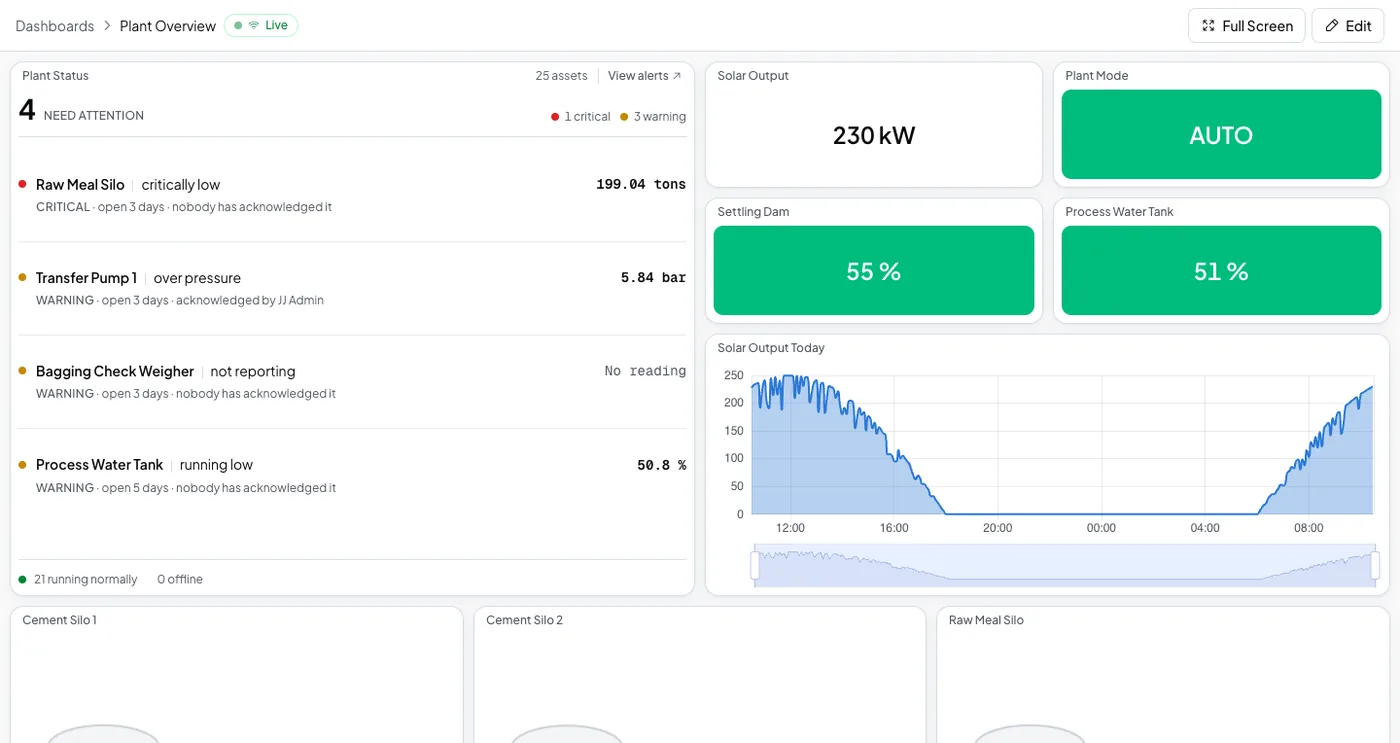
A dashboard built by dragging widgets onto a grid, from a template for the equipment you run.
LogableRiverside Cement WorksJD
ThingsBoard is an open platform you host and build on. Logable is a hosted product with presets and dashboard templates, so the first alert lands on day one.
ThingsBoard is a platform to build on. Logable is a product to use. The right answer depends on whether you want to run a server.
Community Edition is Apache 2.0 and runs on your own server with no licence fee and no device ceiling.
Rule chains transform a reading, enrich it and call other systems. Logable's triggers are a fixed condition set.
Device types, dashboard templates and alert presets are already written, and there is no server to size or patch.
Every row on the left carries the page it was read from. The ThingsBoard column describes the Professional Edition unless the row says otherwise.
| ThingsBoard | Logable | |
|---|---|---|
| MQTT | Yes. A native device protocol, including MQTT Sparkplug B. [1] | Yes. MQTT over TLS. A device publishes to its own topic with its own token. |
| HTTPS and REST | Yes. HTTP is a native device protocol, alongside CoAP, LwM2M and SNMP. [1] | Yes. HTTPS. One POST per reading to the device endpoint, with a device token. |
| Modbus | Through a gateway. Modbus RTU and Modbus TCP through the ThingsBoard IoT Gateway's Modbus connector, which bridges to the platform over MQTT. [1] | Through a gateway. Modbus RTU and Modbus TCP through a gateway that publishes MQTT. A field guide covers the setup. |
| LoRaWAN | Partial. LoRaWAN and LPWAN networks in the Professional Edition, behind ChirpStack, The Things Network, LORIOT, Actility ThingPark or SigFox. [1] | No LoRaWAN support. A LoRaWAN network server can post readings over HTTPS, but Logable decodes no LoRaWAN payloads. |
| Dashboards | Yes. Dashboards with a widget library, built on the same rule engine. [2] | Yes. A drag and drop dashboard builder. 50 dashboards on every plan. |
| Alert rules | Yes. Rule chains transform, enrich and raise alarms. They are programmed rather than chosen from a list. [2][1] | Yes. Trigger rules with ready-made presets, deadband, confirmation samples and dwell. No per-plan limit on the number of rules. |
| Escalation and quiet hours | No. Escalation is something you build in a rule chain. No escalation policy or quiet-hours setting is listed on the pricing page. [2] | Yes. Escalation policies with stages and quiet hours. Alerts reach email, push and the in-app inbox. |
| Reports | Yes. Reporting is a Professional Edition feature. [2] | Yes. A report builder on Growth and above. Saved and scheduled reports on Business and above. |
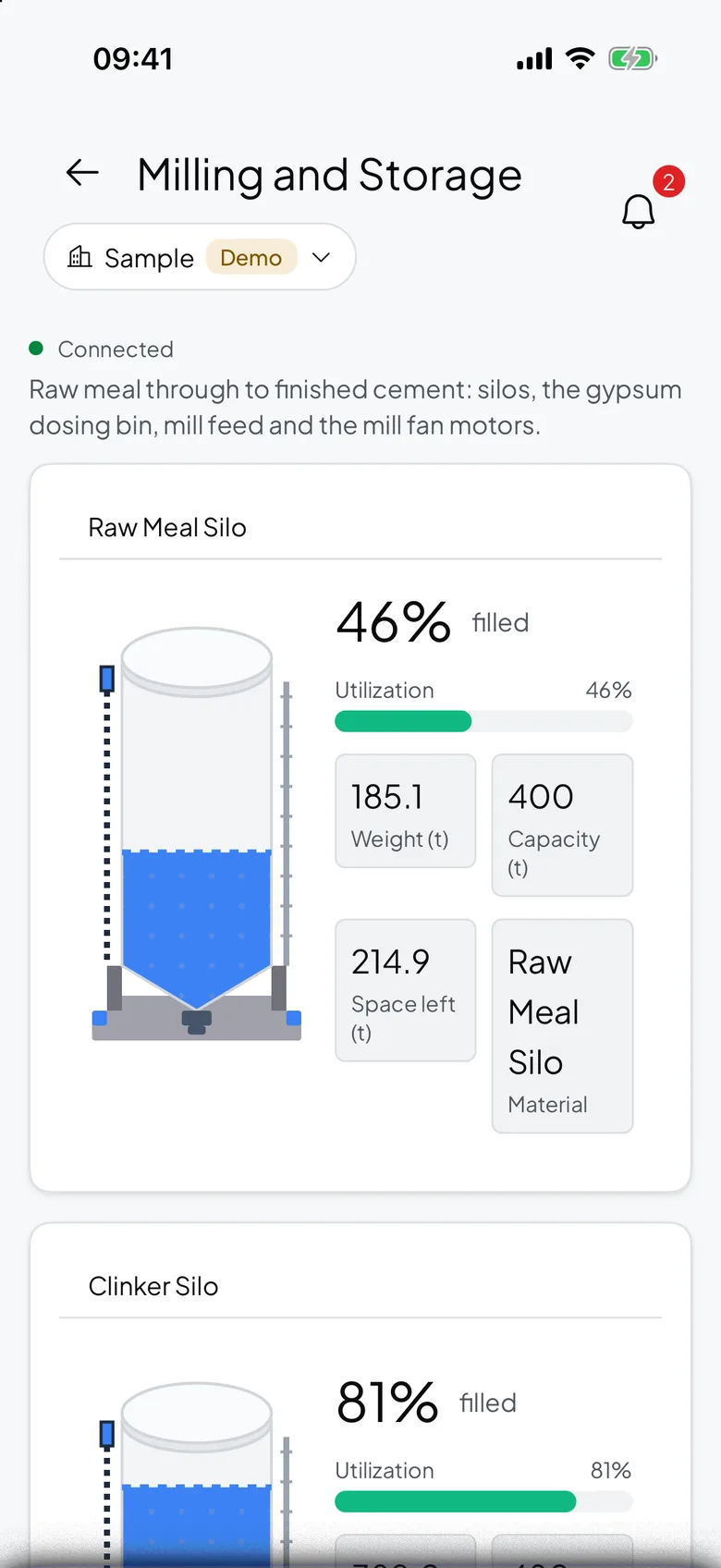
| Mobile app | Yes. An open-source Flutter app published as ThingsBoard Live on Google Play and the App Store, and rebrandable so you publish your own. [3] | Partial. An iOS and Android app for dashboards, devices and alerts, with push alerts on Growth and above. The public store listings are not open yet. |
| Organizations and roles | Yes. Tenants, customers and users, with white labelling from the Pilot plan up. [2] | Yes. Organizations with four roles: viewer, member, admin and owner. One login covers every site you manage. |
| Your own branding | Yes. White labelling from the self-managed Pilot plan at USD 99 a month. [2] | Yes. Your logo and brand colour across the whole dashboard, on the Industry plan. Partners run client organizations from one account. |
| Hosted for you | Yes. ThingsBoard Cloud: a tier at 5 devices and 1M data points a month, then USD 49, USD 149 and USD 749. [2] | Yes. Hosted by Logable. Nothing to install. |
| Self-hosted | Yes. Community Edition is open source under Apache 2.0, with unlimited devices. Professional Edition is self-managed from USD 10 a month. [2] | No self-hosted edition and no on-premise licence. |
| How it is priced | Priced by edition, by device count and by data points a month, with separate ladders for self-managed, cloud and private cloud. [2] | A flat price per plan, sized by device count. Monthly or annual, where annual pays for ten months. |
| Entry price | Community Edition carries no licence fee and is self-hosted. Self-managed Maker is USD 10 a month for 10 devices. [2] | Starter is R399 a month for 8 devices, or USD 25. A 14 day trial covers 5 devices and asks for no card. |
| Data retention | Retention is controlled by the TTL settings you configure. [2] | Raw readings for 60 days. Hourly and daily summaries are kept after that. |
| Support | Community support through GitHub on Community Edition. A help desk from the Pilot plan up. [2] | Email support through the contact page on every plan. Priority support on the Industry plan. |
Checked on 12 September 2026.
If a row here is wrong, tell us and we will correct it. Report a correction.
Five reasons to run ThingsBoard instead. Every one of them is in the table above.
Five reasons to buy Logable instead, each one checked in the product.
Nothing to install, patch or upgrade.
Logable runs as a hosted service. There is no server to size, no database to tune and no version to migrate.
There is no import path between the two products. A device or a gateway is pointed at the Logable MQTT or HTTPS endpoint with a new token, and the history starts from that moment. Rule chains do not convert: the equivalent rules are chosen from the preset library instead. A self-hosted ThingsBoard can keep running beside Logable while you compare the two.
A dashboard built by dragging widgets onto a grid, from a template for the equipment you run.
Transfer Belt 2 falls to 0 m/s, below the 0.1 m/s limit. The push names the belt and the speed, so the call is made before the chute backs up.
No. There is no self-hosted edition and no on-premise licence. Logable is a hosted service, and the upgrade happens on our side. If running the platform on your own server is a requirement, ThingsBoard Community Edition is the honest answer.
No. Logable has trigger rules with a fixed condition set: a limit, a deadband, a number of confirmation samples and a dwell time, chosen from a preset library. That covers the alerting a plant needs and is quicker to set up. It does not transform readings or call out to other systems the way a rule chain does.
Through a gateway on your own network. It reads the Modbus registers and publishes them to Logable over MQTT. ThingsBoard ships its own gateway software with a Modbus connector, which does the same job with one fewer supplier.
No. Your logo and brand colour appear across the whole web dashboard on the Industry plan, and partners run client organizations from one account. The mobile app is not rebrandable. The ThingsBoard Flutter app is.
Open the live demo, or talk to us about the equipment you want to watch.