One screen for every site
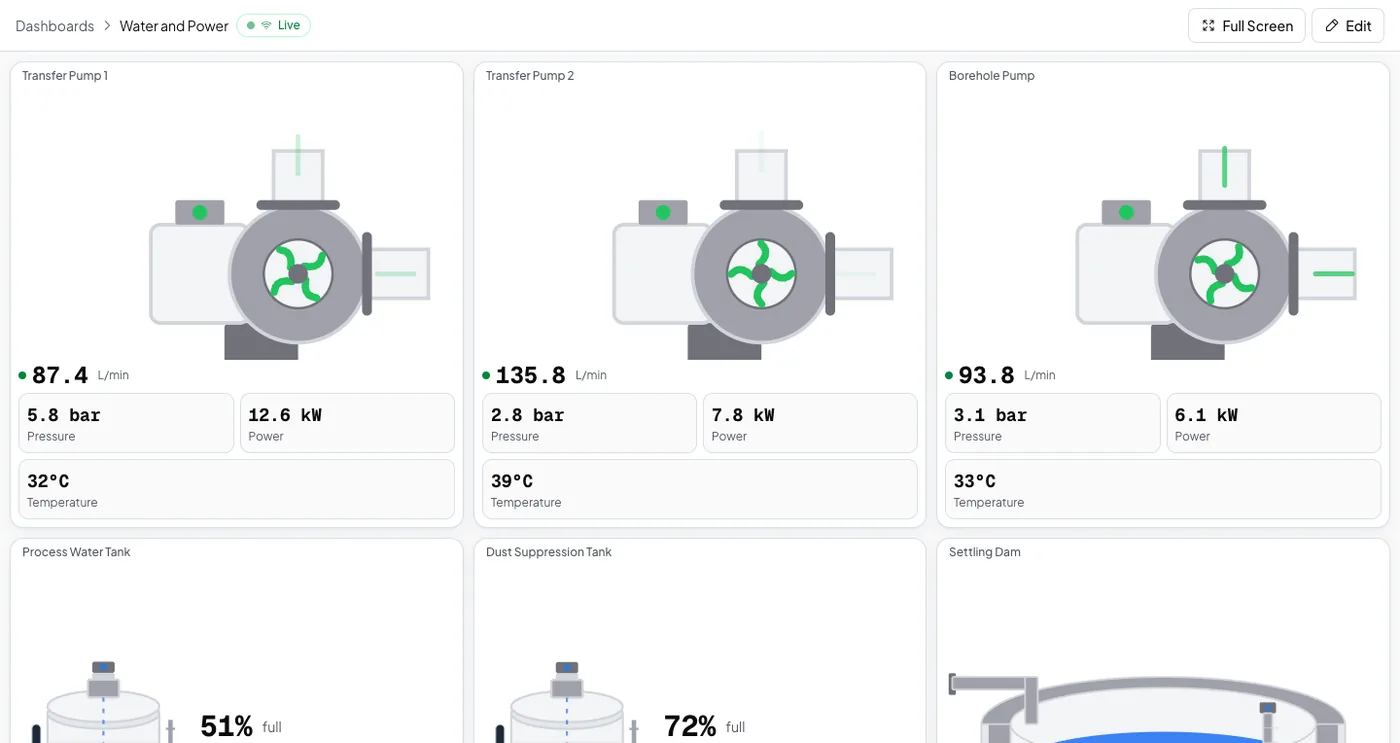
A dashboard built by dragging widgets onto a grid. The same screen opens on a laptop, a phone or a wall display.
LogableRiverside Cement WorksJD
Datacake runs its own LoRaWAN network server. Logable takes MQTT and HTTPS, and ships alert presets written for silos, belt scales and weigh bins.
Both products take readings from equipment and draw them on a dashboard. The difference is what the sensors are, and what happens when a reading is wrong.
Datacake runs a network server and connects to the main third-party ones. Logable decodes no LoRaWAN payloads.
Silos, belt scales, weigh bins and check weighers have ready-made rules with the condition already set.
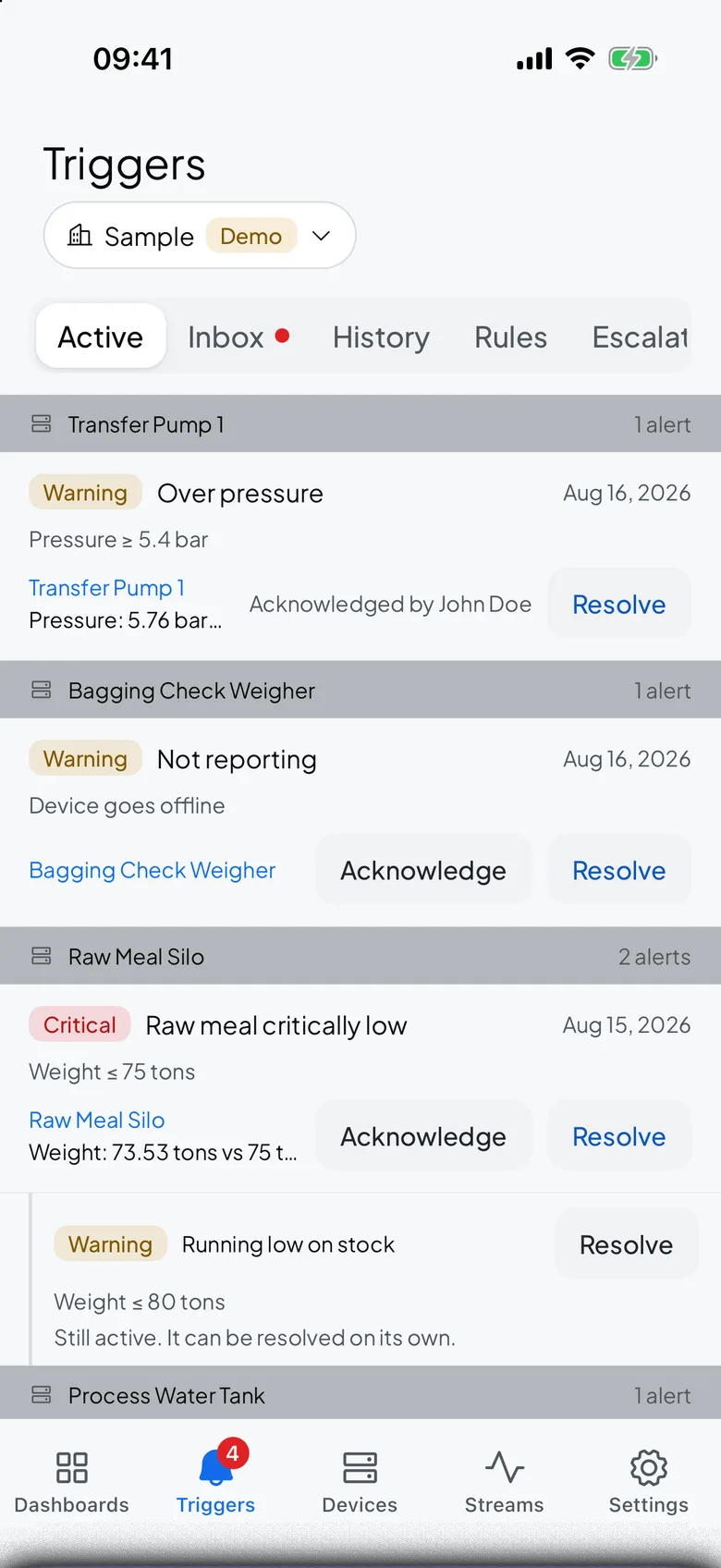
Logable tells the next person when the first one does not acknowledge, and holds a non-critical alert through quiet hours.
Every row on the left carries the page it was read from. Logable's side is one shared list, so no two comparison pages can describe the product differently.
| Datacake | Logable | |
|---|---|---|
| MQTT | Yes. A TLS MQTT endpoint, and an integration in which Datacake subscribes to your own broker and decodes the payload. [1][2] | Yes. MQTT over TLS. A device publishes to its own topic with its own token. |
| HTTPS and REST | Yes. HTTP API devices with custom JSON decoders, incoming and outgoing webhooks, and a GraphQL API. [2] | Yes. HTTPS. One POST per reading to the device endpoint, with a device token. |
| Modbus | Through a gateway. A third-party integration named Grandcentrix Modbus. The documentation index lists no Modbus connector inside the platform. [2] | Through a gateway. Modbus RTU and Modbus TCP through a gateway that publishes MQTT. A field guide covers the setup. |
| LoRaWAN | Yes. Its own LoRaWAN network server, plus The Things Stack, ChirpStack, Loriot, Actility, Helium, Kerlink, Senet, Milesight, KPN and Netmore. [2] | No LoRaWAN support. A LoRaWAN network server can post readings over HTTPS, but Logable decodes no LoRaWAN payloads. |
| Dashboards | Yes. Dashboards on every plan. The pricing page states that every plan includes full platform features, unlimited users, and no per-user fees. [3] | Yes. A drag and drop dashboard builder. 50 dashboards on every plan. |
| Alert rules | Partial. Advanced rules are capped per plan: 5 on Hobby, 10 on Light, 50 on Standard and 100 on Plus. [3] | Yes. Trigger rules with ready-made presets, deadband, confirmation samples and dwell. No per-plan limit on the number of rules. |
| Escalation and quiet hours | No. Time Restrictions can limit when a rule action runs. Nothing escalates an alert to a second contact, and nothing delays a notification until a set time. [3][2] | Yes. Escalation policies with stages and quiet hours. Alerts reach email, push and the in-app inbox. |
| Reports | Yes. A reporting engine on Standard and above. [3] | Yes. A report builder on Growth and above. Saved and scheduled reports on Business and above. |
| Mobile app | Yes. A Datacake app on the App Store and Google Play. An app you publish under your own name costs EUR 300 a month plus EUR 2,000 once. [3] | Partial. An iOS and Android app for dashboards, devices and alerts, with push alerts on Growth and above. The public store listings are not open yet. |
| Organizations and roles | Yes. Workspaces separate one tenant from another, with enterprise sign-on through Okta or Entra ID. [2] | Yes. Organizations with four roles: viewer, member, admin and owner. One login covers every site you manage. |
| Your own branding | Yes. White-label domain branding, and a White Label plan for the branded mobile app. [3][2] | Yes. Your logo and brand colour across the whole dashboard, on the Industry plan. Partners run client organizations from one account. |
| Hosted for you | Yes. Hosted by Datacake. [3] | Yes. Hosted by Logable. Nothing to install. |
| Self-hosted | No self-hosted or on-premise deployment appears in the documentation index. [2] | No self-hosted edition and no on-premise licence. |
| How it is priced | One plan per device band: Hobby, Light, Standard, Plus and Enterprise, each with a device ceiling. [3] | A flat price per plan, sized by device count. Monthly or annual, where annual pays for ten months. |
| Entry price | First 5 Devices Free, then Hobby at EUR 25 a month for up to 25 devices. Light is EUR 159 for up to 50. [3] | Starter is R399 a month for 8 devices, or USD 25. A 14 day trial covers 5 devices and asks for no card. |
| Data retention | One year of data retention, and up to two years with an add-on. [3] | Raw readings for 60 days. Hourly and daily summaries are kept after that. |
| Support | Paid support at EUR 200 a month, or EUR 500 a month for the Premium tier. [3] | Email support through the contact page on every plan. Priority support on the Industry plan. |
Checked on 12 September 2026.
If a row here is wrong, tell us and we will correct it. Report a correction.
Five reasons to buy Datacake instead. They are real, and the row above says the same thing.
Five reasons to buy Logable instead, each one checked in the product.
The presets already know what a silo does.
A silo, a belt scale and a weigh bin each arrive with rules written for them. You choose the device and the limit, and the first alert is set.
There is no import path between the two products. A device is pointed at the Logable MQTT or HTTPS endpoint with a new token, and the history starts from that moment. Dashboards are rebuilt from the templates and the rules from the presets, which takes an afternoon for a small fleet. Run both for a week if you want an overlap.
A dashboard built by dragging widgets onto a grid. The same screen opens on a laptop, a phone or a wall display.
Clinker Silo reads 39 t, below the 40 t limit. The push carries the device and the value, so the decision is made before anyone calls the plant.
Not directly. Logable decodes no LoRaWAN payloads. A LoRaWAN network server can post decoded readings to the Logable HTTPS endpoint, which works, but the network server stays in the path and is a second system to run. If the whole fleet is LoRaWAN, Datacake is the better fit.
Raw readings are kept for 60 days. Hourly and daily summaries are kept after that, so a chart over a year still draws and a report over a quarter still runs. Datacake keeps raw data for a year, and for two years with an add-on.
Starter includes 3 members, Growth includes 6 and Business includes 80, across the four roles: viewer, member, admin and owner. Datacake charges no per-user fee on any plan, so a large team is cheaper there.
Through a gateway on your own network. It reads the Modbus registers and publishes them to Logable over MQTT. A field guide covers the setup end to end.
Open the live demo, or talk to us about the equipment you want to watch.